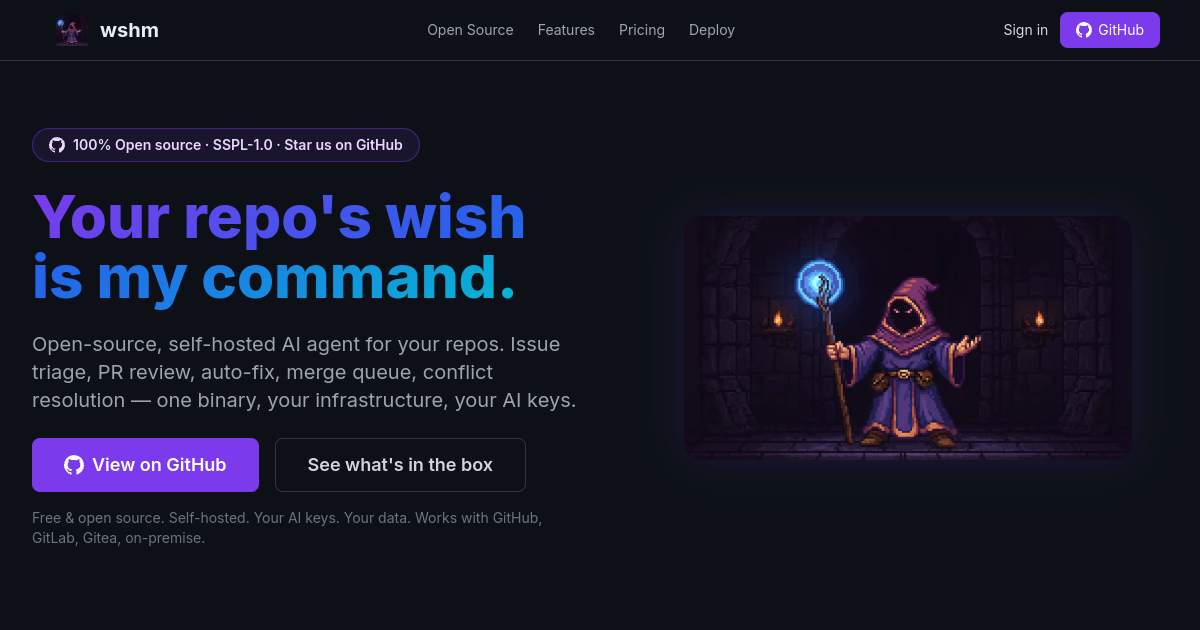
wshm is an open-source, self-hosted AI agent designed to automate repository maintenance tasks for software projects. It addresses workflows such as issue triage, pull request (PR) review, automatic bug fixing, merge queue management, and conflict resolution, all from a single Rust binary that users can run on their own infrastructure. The tool is intended for developers and teams who want end-to-end automation for their repositories while maintaining control over their data, AI keys, and codebase.
Key features include automated issue classification, labeling, prioritization, duplicate detection, and the ability to request missing information or identify quick wins. wshm provides configurable label rules, periodic retriage, and supports custom AI prompts. For PRs, it generates instant AI-powered summaries, risk assessments, and review checklists, and performs line-by-line inline code reviews to catch bugs. The platform can auto-label PRs by type and risk, and for simple bugs, it generates draft PRs, runs test suites, and performs security scans, all gated by confidence thresholds, collaborator authorization, and human review. Merge queue management includes scoring and ranking PRs by readiness, auto-merging those above a threshold, and automatic detection and resolution of merge conflicts without force-pushing.
wshm offers both a terminal-based interactive dashboard (TUI) and a web dashboard, providing real-time overviews of issues, PRs, merge queues, statistics, and drift analysis. The web dashboard is bundled in the open-source binary and served locally from the daemon. The platform integrates with GitHub, GitLab (including self-managed instances), Gitea, Forgejo, Codeberg, and Azure DevOps, supporting both public and private repositories, and can be deployed via VM, Docker, Kubernetes, or as a GitHub Action. Users bring their own AI keys and can connect to providers such as Anthropic, OpenAI, Google, Mistral, Groq, DeepSeek, xAI, OpenRouter, Ollama, Azure, Together, Fireworks, Cohere, and Perplexity, or run local models with Ollama.
0 open-source license and is free for self-hosting, with no SaaS lock-in, no per-seat billing, and no telemetry enabled by default. An optional Pro tier adds a hosted dashboard, SSO, team analytics, RBAC, audit logs, premium features, and email support. An enterprise edition with dedicated support, SLAs, onboarding, and custom AI fine-tuning is planned. wshm emphasizes security with multiple audit rounds, defense-in-depth, prompt injection hardening, and strict authentication and authorization controls. The tool is fork-friendly, allowing users to audit, modify, and extend it to fit their workflows.
In the Autonomous agents & workflows space, wshm takes a focused approach. It focuses on automating and streamlining repository maintenance tasks such as issue triage, PR review, and bug fixing using AI agents. It is built as an open-source project for software developers. wshm is open source under the Open Source license. The product ships for the command line, and it can be self-hosted.
wshm first shipped in 2026. Development happens publicly on GitHub with 67 stars and 168 commits in the last 90 days. PulseGate's similarity index finds few close equivalents — wshm occupies a relatively distinct niche. Key capabilities include issue triage, PR review, and auto-fix bugs. It exposes integrations via a public API.
Latest indexed changes and source events
wshm-dev/wshm discovered by the PulseGate indexer
Other apps tracked under the same category.