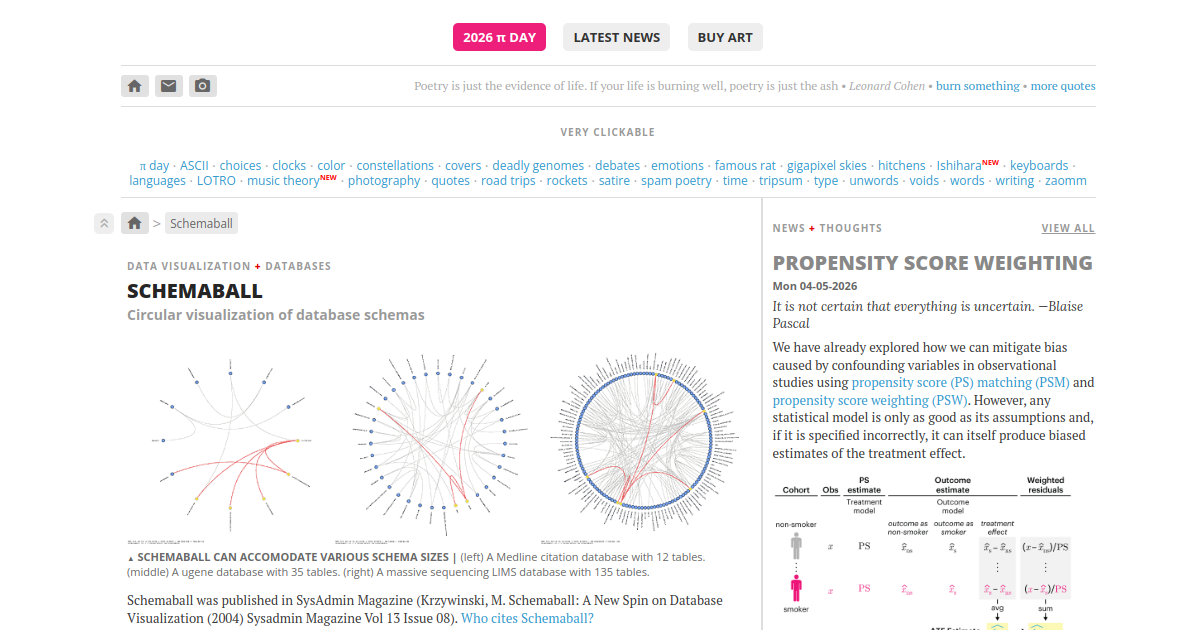
Schemaball is a visualization tool designed for representing SQL database schemas, with a focus on illustrating the relationships between tables. It addresses the challenge of understanding and managing complex database structures, particularly when dealing with large schemas that may contain hundreds of tables and intricate foreign key relationships. By providing a graphical overview, Schemaball helps users keep track of table connections and supports schema development processes.
The tool generates static graphic images that depict tables and the foreign key links between them in a circular layout. Users can highlight or hide specific tables and table links, and traverse foreign key relationships in either direction to emphasize connected tables. Schemaball accommodates schemas of varying sizes, from small databases with a handful of tables to extensive systems with over a hundred tables and numerous interconnections. It is capable of visualizing schemas from different sources, including SQL schema dumps, flat files, or live databases.
Schemaball operates as a Perl-based application and requires certain modules, such as GD, with optional support for Math::Bezier and SQL::Translator. Its output is intended as a static image, which can be further processed if needed. The tool is suitable for database administrators, developers, or anyone involved in designing, maintaining, or analyzing SQL database structures who needs a clear visual representation of table relationships.
Schemaball is presented as a specialized solution for database schema visualization, particularly for users working with SQL databases who require flexible and detailed graphical representations of their database architectures.
Schemaball sits in PulseGate's Diagramming & whiteboards category. It helps developers visualize and understand complex database schemas through graphical diagrams. It is built as an open-source project for database developers and data analysts. Schemaball is open source under the Open Source license. It runs on the web, and it can be self-hosted.
It is developed by Martin Krzywinski (Canada). Key capabilities include schema visualization, circular diagrams, and open source.
Latest indexed changes and source events
Other apps tracked under the same category.