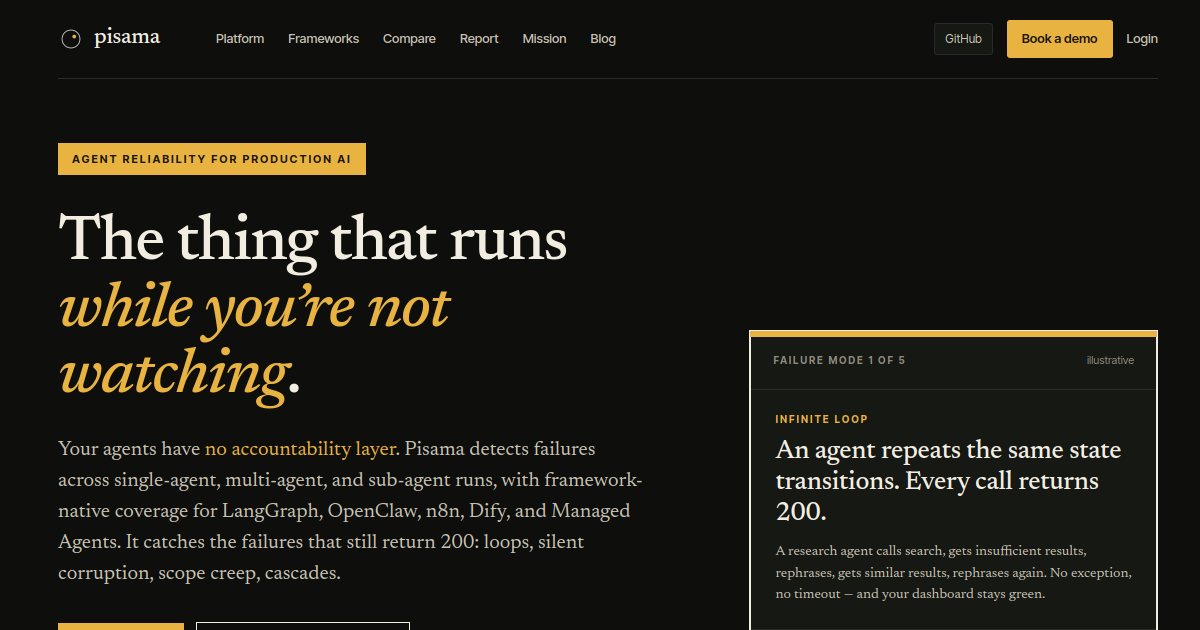
Pisama is a platform focused on agent forensics and reliability for production AI systems, designed to provide an accountability layer for AI agents operating in production environments. It addresses the problem of undetected failures in agent-based workflows, including issues that do not trigger exceptions or visible errors, such as infinite loops, silent corruption, scope creep, cascading failures, and other subtle faults that standard monitoring might miss. Pisama analyzes production traces to identify and attribute the first upstream failure across single-agent, multi-agent, and sub-agent runs, offering framework-native support for LangGraph, OpenClaw, n8n, Dify, and Managed Agents.
The platform employs 87 detectors to monitor every agent trace, with the majority of detectors focused on structural issues and running locally at no cost. These detectors are organized into six categories, including planning and decomposition, execution and state, coordination, verification and quality, behavior and safety, and reasoning and observability. Pisama provides detailed explanations in plain language for each detected failure, specifying what broke, where it broke (down to the exact agent and step), and offering suggested fixes. For certain frameworks like LangGraph, the platform can automatically open a pull request in the user's repository with the proposed fix. Auto-fix capabilities for additional frameworks such as n8n, Dify, OpenClaw, and Anthropic Managed Agents are planned.
ai. The SDK handles detection and diagnosis in an open-source manner, while the healing (auto-fix) feature is available on the hosted platform for select frameworks. The platform is compatible with a range of agent frameworks, runtimes, and editors, and supports integration via adapters and OpenTelemetry ingestion. Pisama is implemented in TypeScript and Python and is distributed under the MIT license. The service distinguishes between open-source components (detect and diagnose) and hosted features (heal), with clear delineation of which parts are free and which may incur costs.
The tool is intended for platform teams and enterprises responsible for deploying and maintaining AI agents in production, particularly those concerned with operational reliability, cost control, and auditability. Pisama's approach emphasizes proactive detection, detailed attribution, and actionable remediation of agent failures, aiming to reduce undetected errors and improve trust in automated agent systems.
In the Infrastructure & Backend space, pisama-core takes a focused approach. It enables developers to implement agent forensics with detection, scoring, and self-healing in their systems. It is built as an open-source project for developers building agent-based or forensic systems. pisama-core is open source under the MIT license. pisama-core is available on the web, the command line, and API, and it can be self-hosted.
pisama-core first shipped in 2026. Development happens publicly on GitHub with 9 commits in the last 90 days. Key capabilities include detection engine, scoring system, and self-healing.
Latest indexed changes and source events
Other apps tracked under the same category.