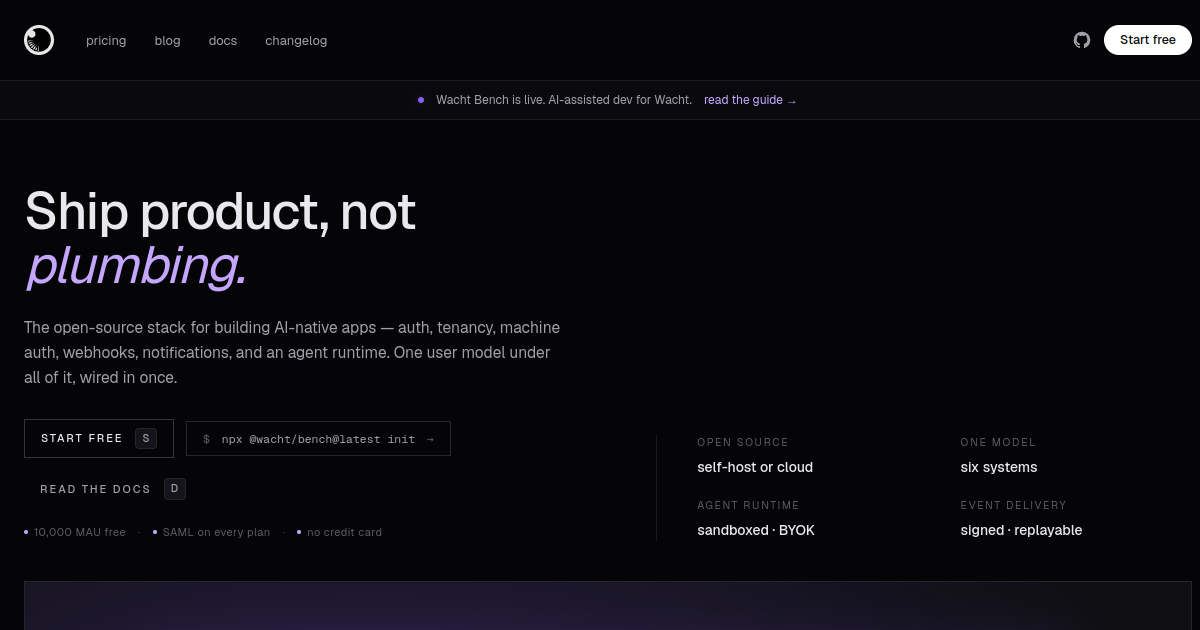
Wacht is an open-source infrastructure stack designed for building AI-native applications, offering a unified model for user and organization management across multiple core systems. It addresses the complexity of integrating identity, authentication, tenancy, machine authentication, webhooks, notifications, and agent runtimes by providing these as prebuilt, interoperable modules under a single architecture. This approach eliminates the need to stitch together multiple vendors or services, streamlining the development process for teams building AI-driven products.
The platform features six primary systems: identity (with support for passwordless authentication, passkeys, multi-factor authentication, OAuth, and SAML SSO, including RBAC and a hosted UI), multitenancy (workspaces, invitations, roles, domain auto-join, and per-organization configuration), machine authentication (API keys, OAuth apps, and credentials with scope, tenant, and rate limit gating), webhooks (at-least-once signed delivery, retries, and replay to any endpoint), notifications (in-app inbox and real-time streams via a unified API, scoped to users, organizations, and workspaces), and an agent runtime (sandboxed agents, bring-your-own keys and storage, approvals and hooks on every tool call, with isolation via Firecracker microVMs). All systems are built on a single user and organization model, ensuring consistency and reducing integration overhead.
js, React Router, TanStack Router, and Rust, enabling typed, end-to-end integration across web and backend stacks. It includes prebuilt authentication UI components for sign-in, consent, tenancy, account management, and onboarding, which can be embedded directly into applications and are already connected to the Wacht backend. The platform is suitable for a range of products, especially AI SaaS applications requiring identity, tenancy, usage limits, and agent runtimes, and allows adoption of one or all of its systems as needed.
Delivery options include self-hosting on users' own infrastructure or using a hosted cloud service. Wacht is open source, with code available on GitHub, and emphasizes security features such as tenant isolation, encrypted secrets, signed webhook delivery, and enterprise authentication controls. Pricing includes a free tier with real production limits, offering up to 10,000 monthly active users, 500 organizations, 2,000 workspaces, SAML SSO, and access to the agents platform without requiring a credit card. Audit logs and human approval gates are also provided for operational transparency and control.
Open source infrastructure sits in PulseGate's Infrastructure & Backend category. It focuses on reducing the complexity of building and scaling AI-native applications by providing unified infrastructure components. Open source infrastructure is an open-source project aimed at developers building AI-native apps. The project is open source (Open Source). The product ships for the web and the command line, and it can be self-hosted.
Open source infrastructure first shipped in 2026. Among its 7 catalogued features are identity management, organization support, and machine auth.
Latest indexed changes and source events
Other apps tracked under the same category.