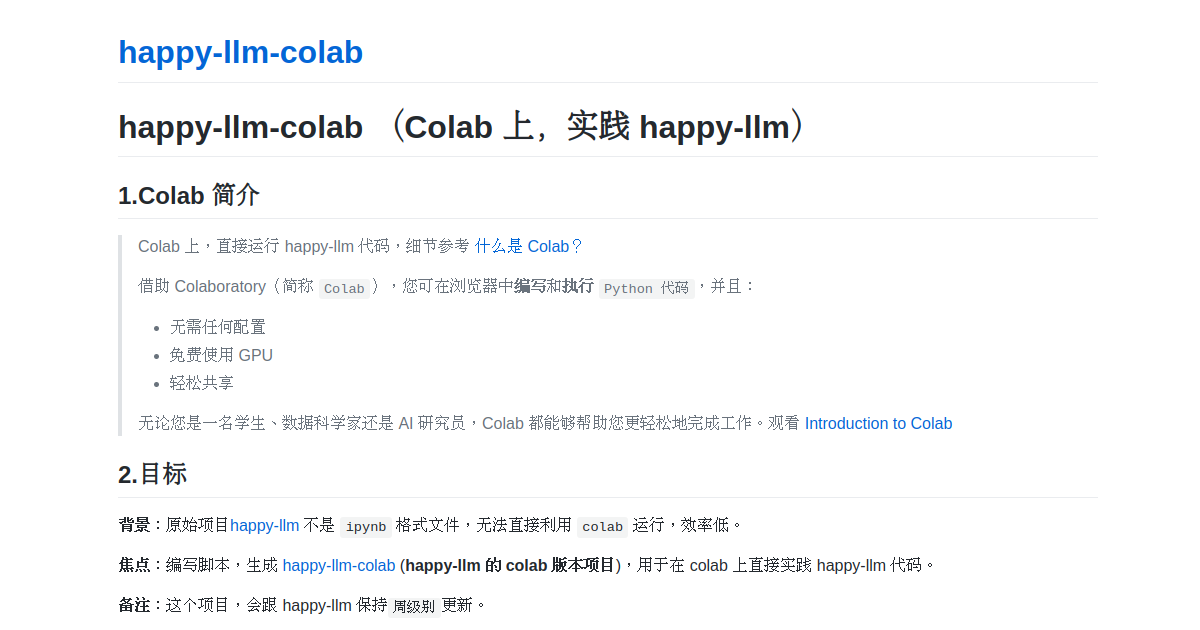
happy-llm-colab is a project designed to facilitate the practical use of the happy-llm codebase within Google Colab. By offering scripts that automatically generate Colab-compatible notebooks, happy-llm-colab enables users to execute and experiment with happy-llm code in a browser-based environment without additional configuration.
The project features a structured set of chapters covering foundational and advanced topics in natural language processing (NLP) and large language models (LLMs). These chapters include introductions to NLP concepts, the Transformer architecture, pretraining strategies, hands-on guides for building models such as LLaMA2, and practical training techniques like supervised fine-tuning and LoRA/QLoRA. Additional sections focus on model evaluation, retrieval-augmented generation (RAG), and agent-based applications. The resource also includes a collection of blog posts and learning notes contributed by the community.
happy-llm-colab is intended for a wide range of users, including students, data scientists, and AI researchers who wish to learn about or experiment with NLP and LLM workflows. The platform leverages Google Colab's free GPU resources, allowing users to write and execute Python code directly in their browsers. To use the provided scripts, users are instructed to install certain dependencies and execute a shell script that generates the necessary notebooks.
The project is open source, and its site encourages community contributions. Regular updates are maintained to keep the Colab materials in sync with the original happy-llm project. There is no mention of any cost associated with using happy-llm-colab, and it is positioned as a freely accessible educational and practical tool for working with large language models on Colab.
In the Other AI space, Ningg takes a focused approach. It focuses on simplifying the process of running and experimenting with large language models on Google Colab for learning and research. Ningg is an open-source project aimed at AI researchers and students. The project is open source (Open Source). Ningg is available on the web and the command line.
ningg builds and maintains Ningg, and the product first shipped in 2025. The project is developed in the open on GitHub with 72 stars and 2 commits in the last 90 days. Among its 5 catalogued features are colab integration, notebook automation, and LLM training scripts.
Latest indexed changes and source events
ningg/happy-llm-colab verified by the PulseGate indexer
Other apps tracked under the same category.