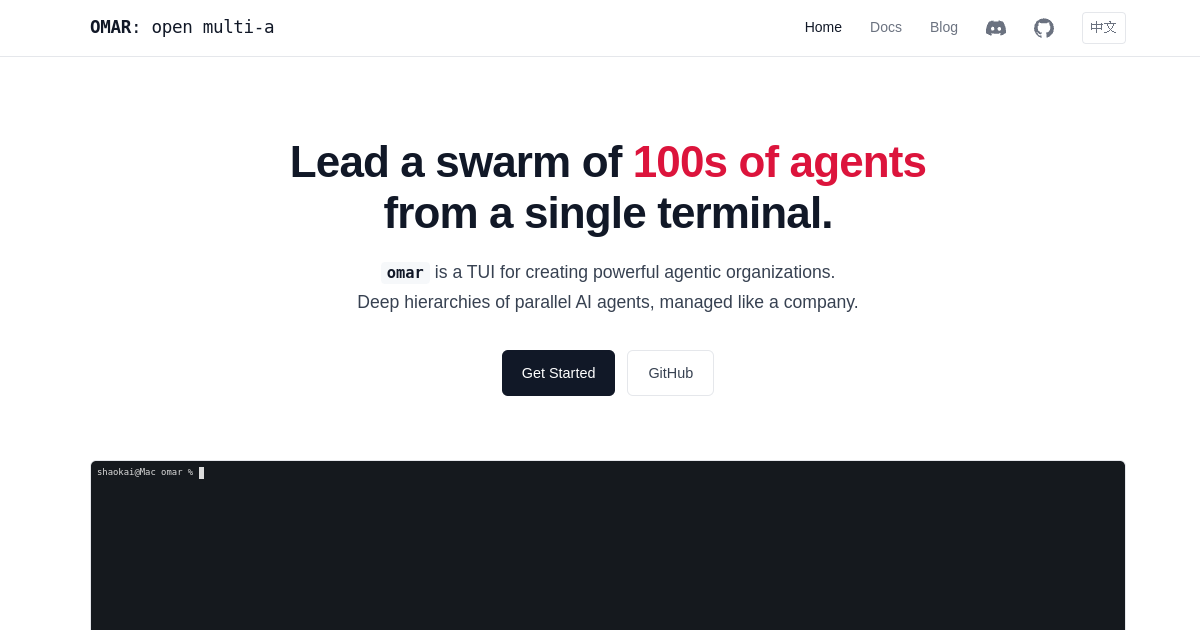
OMAR is a terminal user interface (TUI) designed for orchestrating and managing large numbers of AI agents from a single terminal environment. The tool enables users to create deep hierarchies of parallel AI agents, structuring them in organizations that can mirror company-like management, where agents can oversee other agents and work collaboratively on complex tasks.
A notable feature of OMAR is its support for heterogeneous model backends, allowing different AI models such as Claude, Codex, Cursor, and Opencode to work together within the same agentic organization. Users can assign specific models to different tasks, enabling a mix-and-match approach that leverages the strengths of each backend. The platform also provides full control over agent interactions, including the ability to communicate with and manage any subagent directly. Navigation within agent hierarchies is facilitated by arrow keys and interactive popups, making it possible to oversee and adjust agent structures dynamically.
OMAR offers flexibility in agent lifespans, supporting both long-running and ephemeral agents. It maintains persistent state across sessions through memory snapshots, ensuring continuity in agent operations and workflows. The tool integrates with Slack channels, allowing agents to participate in messaging workflows and bridging interactions between human and AI participants. Built on top of tmux, OMAR inherits all tmux commands and key bindings, offering robust session management and high customizability for users familiar with terminal multiplexing.
Installation is supported on macOS and Linux platforms, with options to install via a shell script, Homebrew, or from source using Rust and GNU Make. 0 or higher and at least one compatible agent backend. The tool is distributed under the BSD 3-Clause license, making it available for open-source use and modification.
OMAR sits in PulseGate's Autonomous agents & workflows category. It focuses on coordinating and managing large numbers of AI agents efficiently from a single terminal interface. It is built as an open-source project for AI researchers and developers. OMAR is open source under the Open Source license. The product ships for the command line.
It is developed by lsk567 (GitHub), and the product first shipped in 2026. Development happens publicly on GitHub with 42 stars and 50 commits in the last 90 days. Key capabilities include agent orchestration, deep hierarchies, and parallel execution.
Latest indexed changes and source events
Other apps tracked under the same category.