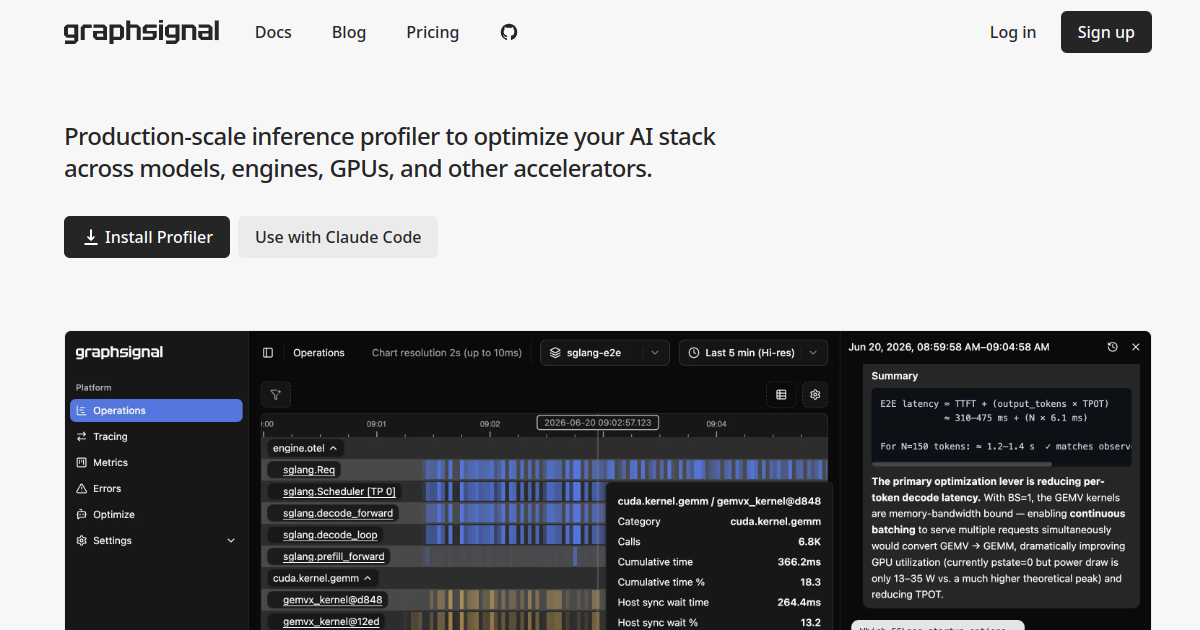
Graphsignal is a production-scale inference profiler designed to optimize AI stacks by providing detailed insights across models, engines, GPUs, and other accelerators. The tool addresses the need for in-depth performance analysis and optimization in AI inference workloads, focusing on identifying bottlenecks and improving efficiency throughout the inference stack.
Key features include continuous, high-resolution profiling timelines that reveal operation durations and resource utilization, enabling users to monitor performance in real time. Graphsignal also offers LLM generation tracing, delivering per-step timing, token throughput, and latency breakdowns for major inference frameworks. This tracing capability helps pinpoint performance issues specific to large language model (LLM) workloads. The platform collects system-level metrics from inference engines and hardware components such as CPUs, GPUs, and other accelerators, providing a comprehensive view of resource usage.
Error monitoring is another core capability, with the tool tracking device-level failures and inference errors to aid in debugging and maintaining reliability in production environments. For AI agents, Graphsignal supplies inference telemetry that supports the identification of performance bottlenecks and informs targeted improvements across the stack. The tool is compatible with a range of frameworks and engines, including Claude, Code, NVIDIA, PyTorch, vLLM, SGLang, and TensorRT, allowing integration into diverse AI workflows.
Graphsignal is intended for those managing or optimizing AI inference in production, such as AI engineers and developers seeking to enhance performance and reliability. The tool is developed by Graphsignal, Inc.
In the AI & ML space, Graphsignal takes a focused approach. It focuses on identifying and resolving performance bottlenecks in AI inference workloads at production scale. It is built as a B2B product for AI engineers. Graphsignal follows a freemium model. It runs on the web and the command line.
Graphsignal first shipped in 2026. Development happens publicly on GitHub with 225 stars and 13 commits in the last 90 days. Key capabilities include inference profiling, LLM tracing, and system metrics.
Latest indexed changes and source events
Other apps tracked under the same category.