
GitHub Spec Kit
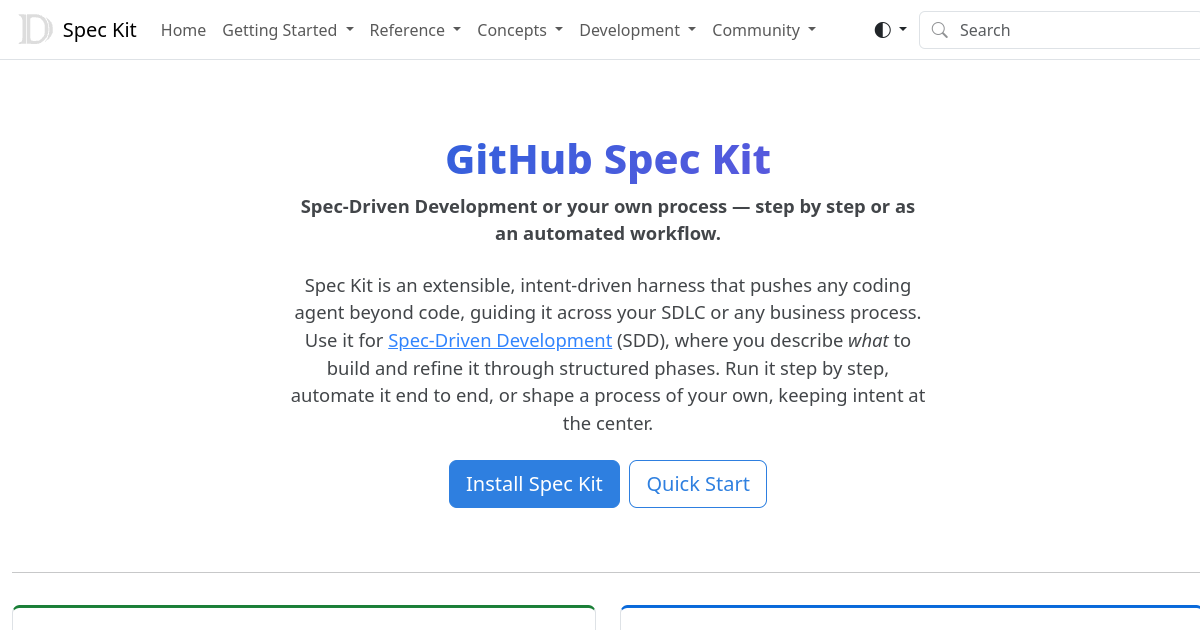
GitHub Spec Kit is an extensible harness for guiding AI coding agents through structured processes such as Spec-Driven Development. It addresses the challenge of providing agents with consistent context across phases of software development rather than relying on ad-hoc prompts.
The tool ships with a default Spec-Driven Development workflow consisting of the phases Spec, Plan, Tasks, and Implement. Each phase employs rich templates, quality checklists, and cross-artifact analysis to produce Markdown artifacts. These artifacts supply structured context that feeds forward to subsequent phases. Users can execute the workflow interactively step by step, run it as an automated end-to-end process, or adapt it to custom business processes while maintaining intent at the center.
Spec Kit supports 35 integrations with coding agents including Copilot, Gemini, Codex, Kilo Code, Zed, Claude, Forge, and Kiro. A single command switches between agents and automatically sets up the appropriate command files and directory structures. A generic integration serves as an option for any unlisted agent. The tool also provides 138 community extensions contributed by more than 70 authors along with 25 presets that allow users to tune the core process or create extensions of their own.
It is delivered as a command-line tool that is installed and invoked via commands such as specify init. The documentation presents it as suitable for developers and teams working with AI coding agents in any SDLC or business process.
Open SourceWebCLISelf-hosted
Overview
6 featuresGitHub Spec Kit is a Developer Tools project. Lack of structured, intent-driven guidance when using AI coding agents across the full software development lifecycle. GitHub Spec Kit is an open-source project aimed at developers. GitHub Spec Kit is open source under the Open Source license. It ships for the web and the command line, and it can be self-hosted.
GitHub builds and maintains GitHub Spec Kit, and it first shipped in 2024. Among its 6 catalogued features are Spec-Driven Workflow, Agent Integrations, and Markdown Artifacts. It exposes integrations via a public API.
Summary written by a language model from the project’s public pages.
- Spec-Driven Workflow
- Agent Integrations
- Markdown Artifacts
- Community Extensions
- Presets
- Quality Checklists
Tags
spec-driven-developmentai-coding-agentsdlc-workflowagent-orchestrationmarkdown-artifacts
AI capabilities
Code
Inference: Hybrid
Built with & integrations
AI providers
multiple
Connectors
API
Runs on
BrowserCLISelf-hosted
Trust & compliance
License
Open Source
Verified signals
HTTPSOpen Source
Indexing history
1What PulseGate has recorded for this listing
Frequently asked questions about GitHub Spec Kit
- What is GitHub Spec Kit?
- Lack of structured, intent-driven guidance when using AI coding agents across the full software development lifecycle. It is catalogued under Developer Tools on PulseGate.
- Who should use GitHub Spec Kit?
- GitHub Spec Kit is an open-source project built for developers.
- Is GitHub Spec Kit free?
- Yes — GitHub Spec Kit is open source under the Open Source license and free to use.
- What platforms does GitHub Spec Kit run on?
- GitHub Spec Kit runs on the web and the command line. It can also be self-hosted.
- Is GitHub Spec Kit still maintained?
- Unverified. GitHub Spec Kit has not been re-checked since it entered the index, so there is no finding either way — and only a positive finding would say otherwise.
- Who makes GitHub Spec Kit?
- GitHub Spec Kit is developed by GitHub.
- When did GitHub Spec Kit launch?
- GitHub Spec Kit first shipped in 2024.
- Is GitHub Spec Kit open source?
- Yes — GitHub Spec Kit is open source under the Open Source license.
Similar apps
Closest matches by what these projects do