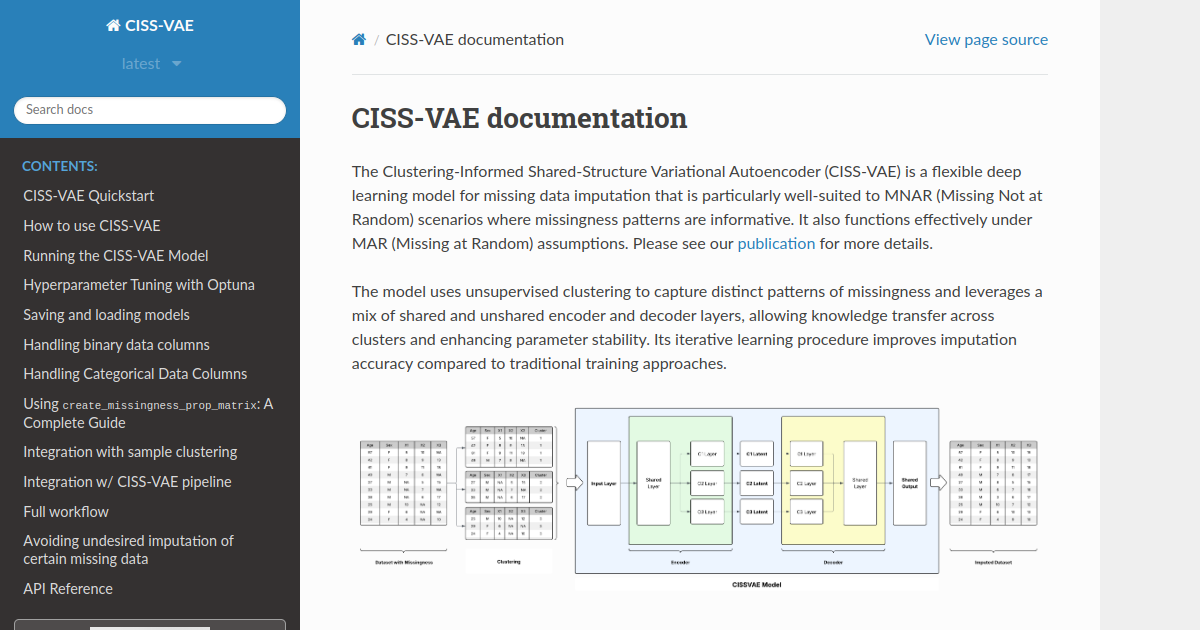
CISS-VAE is a deep learning model designed for missing data imputation, with particular effectiveness in scenarios where missingness is informative, such as MNAR (Missing Not at Random) and MAR (Missing at Random) data. The model employs unsupervised clustering to identify distinct patterns of missingness, enabling it to leverage both shared and unshared encoder and decoder layers. This approach facilitates knowledge transfer across clusters and contributes to enhanced parameter stability.
The tool features an iterative learning procedure that aims to improve imputation accuracy compared to conventional training methods. CISS-VAE includes support for handling binary and categorical data columns, as well as tools for creating missingness proportion matrices. autotune(), which allows users to search for optimal model parameters within a user-defined space. This autotune function is compatible with the Optuna Dashboard, enabling visualization of hyperparameter importance trends.
CISS-VAE is available for installation via PyPI or directly from its GitHub repository. The documentation references an associated R package, rCISS-VAE, for users who work in the R environment. The tool is aimed at those seeking advanced methods for data imputation in structured datasets where missing data patterns are non-random or complex. The documentation and API reference provide guidance on integrating the model into workflows, running the model, tuning hyperparameters, and managing different data types within the imputation process.
The documentation credits Yasin Khadem Charvadeh, Danielle Vaithilingam, Kenneth Seier, Katherine S. Panageas, Mithat Gönen, and Yuan Chen.
CISS-VAE documentation sits in PulseGate's Other AI category. It focuses on imputing missing data in datasets, especially with complex missingness patterns, using deep learning. It is built as an open-source project for data scientists and ML researchers. CISS-VAE documentation is open source under the MIT license. CISS-VAE documentation is available on the web, the command line, and API, and it can be self-hosted.
CISS-VAE documentation first shipped in 2025. Development happens publicly on GitHub with 18 commits in the last 90 days. Key capabilities include missing data imputation, variational autoencoder, and clustering integration.
Latest indexed changes and source events
Other apps tracked under the same category.