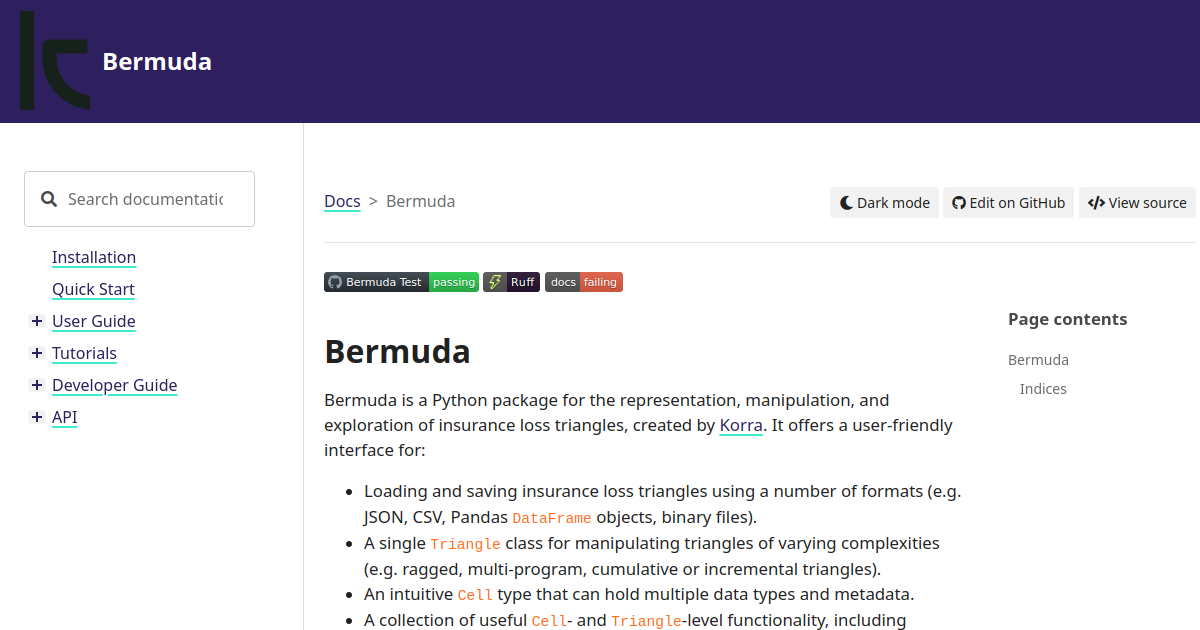
Bermuda is a Python package designed for the representation, manipulation, and exploration of insurance loss triangles. Developed by Korra, it addresses the needs of users working with complex insurance triangle data, offering a user-friendly interface for managing and analyzing this specialized data structure.
The tool provides functionality for loading and saving insurance loss triangles in multiple formats, including JSON, CSV, Pandas DataFrame objects, and binary files. Its core is a single Triangle class, which supports triangles of varying complexities, such as ragged, multi-program, cumulative, or incremental forms. Bermuda introduces an intuitive Cell type capable of holding multiple data types and associated metadata, facilitating more detailed data manipulation and analysis. The package includes a collection of functions at both the Cell and Triangle levels, enabling users to summarize, aggregate, extend, filter, and bootstrap triangle data as needed.
Bermuda also features plotting capabilities, leveraging Altair to visualize triangle structures, loss development dynamics, and predictive distributions along with their associated uncertainty. This makes it suitable for users who wish to explore and communicate insights from insurance triangle data visually. The documentation includes a Quick Start guide, a comprehensive User Guide, and tutorials that demonstrate common usage patterns and explain the underlying data structure and architecture of the package.
However, the tool is delivered as a Python package and offers extensive documentation to support users in its implementation and use.
Bermuda sits in PulseGate's Frameworks & SDKs category. It simplifies the representation, manipulation, and analysis of insurance loss triangles for actuaries and data scientists. It is built as an open-source project for actuaries and insurance data scientists. Bermuda is open source under the MIT license. The product ships for the web and the command line, and it can be self-hosted.
Behind Bermuda is Korra, and the product first shipped in 2025. Development happens publicly on GitHub with 15 stars and 20 commits in the last 90 days. Key capabilities include loss triangle manipulation, data import/export, and aggregation.
Latest indexed changes and source events
Other apps tracked under the same category.