
Agent Lab Journal
Agent Lab Journal publishes an advanced implementation guide for building a durable background AI agent that uses the Gemini API. The 60-minute Node.js tutorial addresses the limitations of synchronous agent endpoints by separating task acceptance from execution. It shows how to accept long-running work over HTTP, return a task identifier immediately, continue processing asynchronously, and report observable progress while reasoning with the Gemini API.
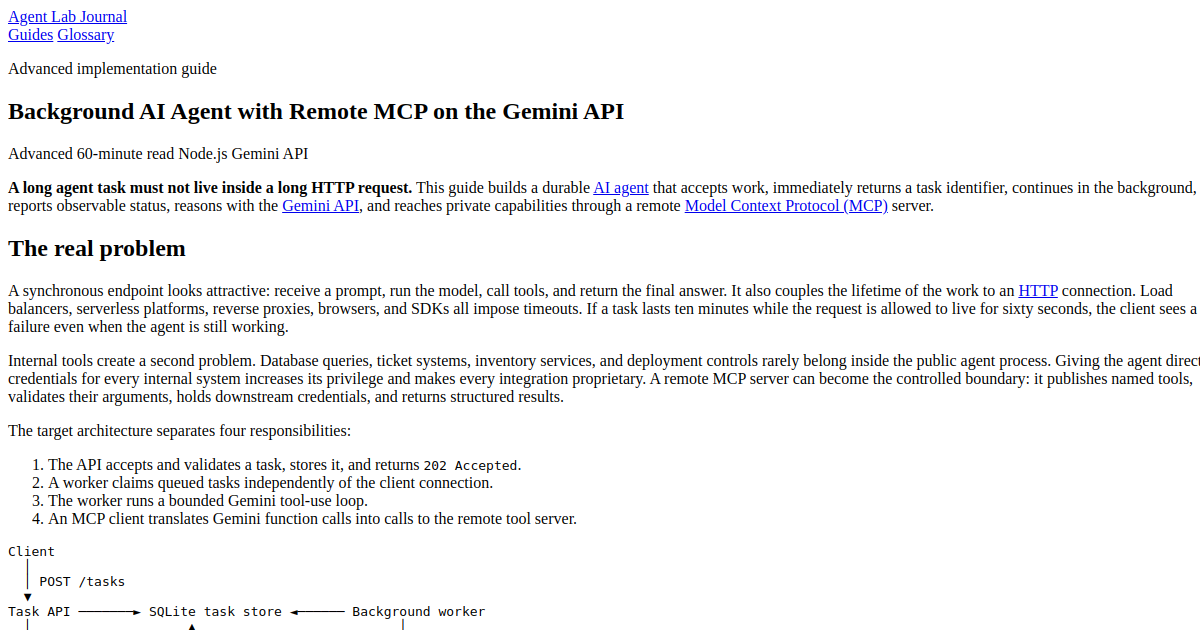
The guide explains two core problems with conventional synchronous designs. Load balancers, serverless platforms, reverse proxies, browsers, and SDKs impose timeouts that can cause client failures even when the agent continues working. Internal tools such as database queries, ticket systems, inventory services, and deployment controls also create risks when placed inside the public agent process, because granting direct credentials increases privilege and ties integrations to proprietary implementations. The architecture therefore routes tool access through a remote Model Context Protocol server that publishes named tools, validates arguments, holds downstream credentials, and returns structured results.
The described system functions as a technical reference within the domain of AI agent development. It positions the remote MCP server as a controlled boundary between the agent and internal capabilities. The content appears on the Agent Lab Journal site, which hosts guides, a glossary, and other advanced implementation material focused on Gemini API usage.
WebCLIAPI
Overview
5 featuresAgent Lab Journal is an AI & ML project. It focuses on long-running AI agent tasks timing out due to HTTP connection limits and insecure exposure of internal tool credentials. Agent Lab Journal is an open-source project aimed at developers. It ships for the web, the command line, and API.
Agent Lab Journal first shipped in 2024. Among its 5 catalogued features are background agents, task identifiers, and progress reporting. It exposes integrations via an MCP server and a public API.
Summary written by a language model from the project’s public pages.
- Background agents
- Task identifiers
- Progress reporting
- Remote MCP tools
- Gemini reasoning
Tags
background-agentsremote-mcpgemini-apidurable-tasksagent-architecture
AI capabilities
TextStructured
Inference: Cloud API
Built with & integrations
AI providers
google_gemini
Connectors
MCPAPI
Runs on
BrowserCLIAPI-only
Detected from
- google_gemini
- bgemini- in the HTML
Trust & compliance
Verified signals
HTTPS
Indexing history
1What PulseGate has recorded for this listing
- Indexed26 Jul · 17:26 UTCBackground AI Agent with Remote MCP on the Gemini API verified against its public sourceSource: PulseGate · Open
Frequently asked questions about Agent Lab Journal
- What does Agent Lab Journal do?
- Agent Lab Journal focuses on long-running AI agent tasks timing out due to HTTP connection limits and insecure exposure of internal tool credentials. It is catalogued under AI & ML on PulseGate.
- Who should use Agent Lab Journal?
- Agent Lab Journal is an open-source project built for developers.
- What platforms does Agent Lab Journal run on?
- Agent Lab Journal runs on the web, the command line, and API.
- Is Agent Lab Journal still active?
- Unverified. Agent Lab Journal has not been re-checked since it entered the index, so there is no finding either way — and only a positive finding would say otherwise.
- What projects are similar to Agent Lab Journal?
- Similar projects tracked by PulseGate include Cliprise, chi-ai, and AI DocuChat.Cliprisechi-aiAI DocuChat
- How long has Agent Lab Journal been around?
- Agent Lab Journal first shipped in 2024.
- Does Agent Lab Journal have an API or integrations?
- Yes — Agent Lab Journal exposes an MCP server and a public API.
Also in AI & ML
Same category — not a similarity match