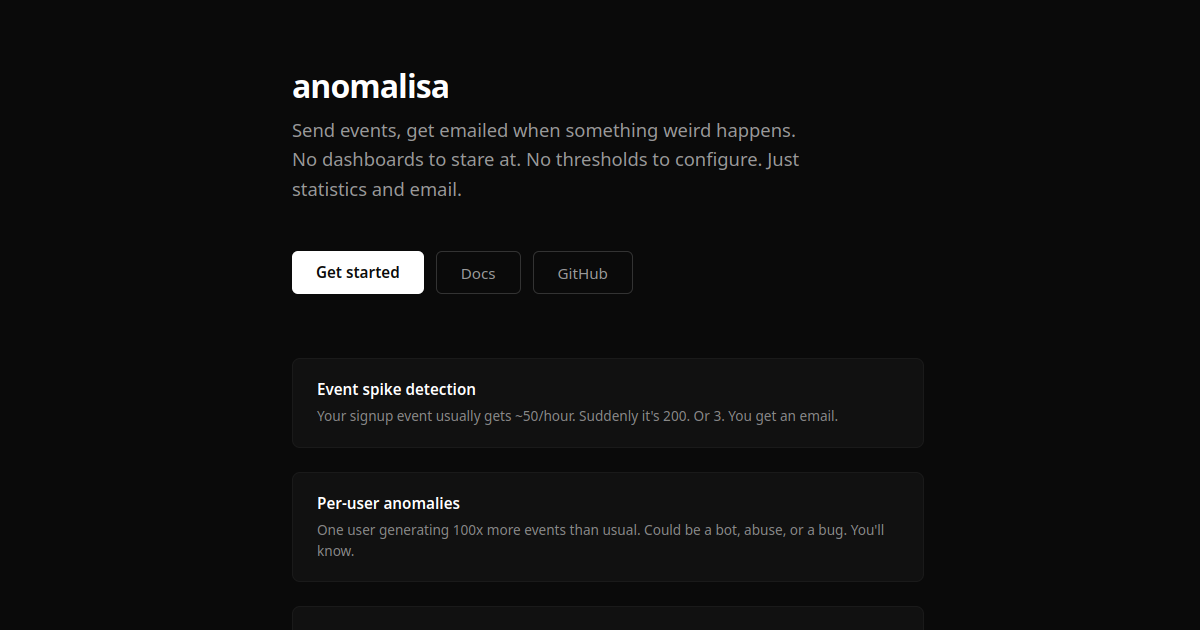
Anomalisa is an open-source anomaly detection tool designed to monitor event streams and notify users via email when unusual patterns are detected. It operates without requiring dashboards or manual threshold configuration, relying instead on statistical analysis to determine what constitutes abnormal behavior in the data. The tool is intended for scenarios where identifying unexpected changes in event counts—such as spikes or drops in user signups or error rates—is critical, and it aims to minimize manual setup and ongoing maintenance.
The detection engine in Anomalisa uses Welford's online algorithm to maintain a running mean and variance for each event type, updating incrementally with every new data point. This allows the tool to detect anomalies when an event count deviates by more than two standard deviations from the learned average. It supports three detection modes from a single event stream: total count anomalies (detecting both spikes and drops in event frequency), percentage spikes (identifying changes in the proportion of specific events like errors relative to overall traffic), and per-user anomalies (flagging users whose activity dramatically deviates from their norm, which could indicate bots, abuse, or integration bugs).
The system is built for simplicity and efficiency, using a key-value store for its storage layer and maintaining event counts in hourly buckets with a seven-day time-to-live (TTL). Anomalies detected are retained for thirty days. The tool’s architecture is designed to avoid the complexity of batch jobs, time-series databases, or relational queries, and its detection logic is contained in a single, easily readable file. Users can interact with Anomalisa by sending events through a simple API, with code examples provided for both npm and Deno environments.
Anomalisa can be self-hosted or used via a hosted version. As open-source software, it allows users to run, modify, or fork the project as needed. The tool is suitable for developers or operations teams seeking statistical anomaly detection for event streams without the overhead of manual configuration or complex infrastructure.
anomalisa sits in PulseGate's LLM eval & observability category. Automatically detecting and alerting on abnormal event patterns without manual threshold configuration. It is built as an open-source project for developers and ops teams. anomalisa is open source under the MIT license. The product ships for the web, API, and the command line, and it can be self-hosted.
It is developed by uri, and the product first shipped in 2025. Development happens publicly on GitHub with 20 stars and 56 commits in the last 90 days. PulseGate's similarity index finds few close equivalents — anomalisa occupies a relatively distinct niche. Key capabilities include anomaly detection, email alerts, and zero configuration. It exposes integrations via a public API.
Latest indexed changes and source events
Other apps tracked under the same category.